
Hire the wrong professional and you get half a solution. A designer can't fix a closet nobody can maintain. An organizer won't choose your sofa, lighting, or finishes. Either mismatch means wasted money and frustration.
Home environment also matters for wellbeing. A UCLA study of 30 families linked stressful descriptions of the home to flatter daily cortisol patterns in wives. It shows an association, not proof that organizing fixes stress, and the sample was small.
This article covers who does what, when to choose each, and when to hire both.
Key Takeaways
- Organizers handle decluttering, storage systems, accessibility, and routines that last.
- Designers shape layout, furniture, color, lighting, finishes, and décor.
- Turn to an organizer when clutter or a life transition is the problem.
- Book a designer when the goal is a new look or a renovation.
- Hire both when a home needs better function and a more refined look.
Professional Organizer vs. Interior Designer: Quick Comparison
| Category | Professional organizer | Interior designer |
|---|---|---|
| Primary goal | Function, order, accessibility, easy upkeep | Look, atmosphere, layout, material palette |
| Typical services | Assess belongings, declutter, categorize, create storage zones, source products, build maintenance habits | Concepts, furniture and décor selection, color, lighting, finishes, layouts, installation support |
| Best fit | Cluttered closets, kitchens, home offices, moves, downsizing, estate clearances | Empty or outdated rooms, redecorating, renovations, furnishing projects |
| Deliverables | Decluttered space, assigned homes for items, custom storage, lasting routines | Design direction, layout recommendations, selections, sourcing guidance, implementation plan |
| Fees | Hourly, package, or project fee | Flat fee, hourly, cost-plus, or a combination |
Both can influence function and appearance. Decide by the outcome you want, not the job title.
Neither profession has a standard national price. NAPO guidance notes organizers charge hourly, by package, or by project, and consultations, supplies, and disposal may cost extra. Designers vary even more, and ASID notes there is no typical fee. Ask either professional for a written scope before you hire.
What Does Each Professional Do?
What Is a Professional Organizer?
According to NAPO, professional organizers help you evaluate belongings, make decisions, and take action around objects, spaces, and data. That is not cleaning, and it is not a weekend tidy-up.
A typical project runs like this:
- Clarify your goals and how you use the space.
- Sort belongings and decide what to keep or release.
- Group items by use.
- Create accessible storage zones.
- Set up habits you can maintain.
A good organizer adapts to you rather than imposing one system. The payoff is less time searching, easier routines, and steadier support during stressful change.
A Life Well Organized (ALWO) follows that path. Its Signature Method moves through Discover, Declutter, Organize, and Balance, and ends with habit-centered systems you can maintain.

Use Cases for a Professional Organizer
Residential projects include:
- Kitchens and pantries
- Closets and bedrooms
- Playrooms and home offices
- Laundry rooms, garages, basements, and attics
- Whole-home projects
Organizers also work with offices and teams. They are especially useful during life transitions:
- Moves and relocation
- Downsizing
- Estates and inheritance
- Divorce
In 2024, 11.8% of Americans moved to a different residence. That is not an organizer-hiring figure, but it shows how common moves are.
Senior move management is a related specialty with its own trade association, NASMM.
What Is an Interior Designer?
Interior designers plan the visual, spatial, and functional experience of a room. That work covers layouts, furniture, color, lighting, materials, finishes, and décor. ASID notes that designers can provide a decorator's services and more, including attention to safety, building codes, and accessibility.
Regulation varies by state. In New York, the title "certified interior designer" is protected, and the scope excludes structural, electrical, plumbing, and HVAC work. Those jobs need licensed engineers, architects, or contractors.
A typical process:
- Discuss lifestyle, taste, and budget.
- Develop a design direction and layouts.
- Select furnishings and finishes.
- Coordinate suppliers or trades, if included.
- Guide installation.

Use Cases for an Interior Designer
Designers are a strong fit when you need to:
- Furnish a new home
- Redesign a living room or primary space
- Create a cohesive look across rooms
- Plan a renovation
- Fix lighting, scale, finishes, or color mismatches
Before hiring, review the designer's portfolio and confirm exactly what the scope includes.
Professional Organizer vs. Interior Designer: Which Should You Choose?
Start with the outcome, not the room. Do you want less stuff and better function, a new look, a renovation, or several at once?
Choose a professional organizer when:
- You're overwhelmed by clutter, belongings without homes, or hard-to-use storage
- Your household can't maintain the current systems
- You're moving, downsizing, clearing an estate, or facing a life change
- You want discreet, empathetic help with hard decisions
Choose an interior designer when:
- Your space works but feels dated, inconsistent, or poorly scaled
- You need furniture, fabric, lighting, finish, or color expertise
- You're planning a renovation or need vendor selection
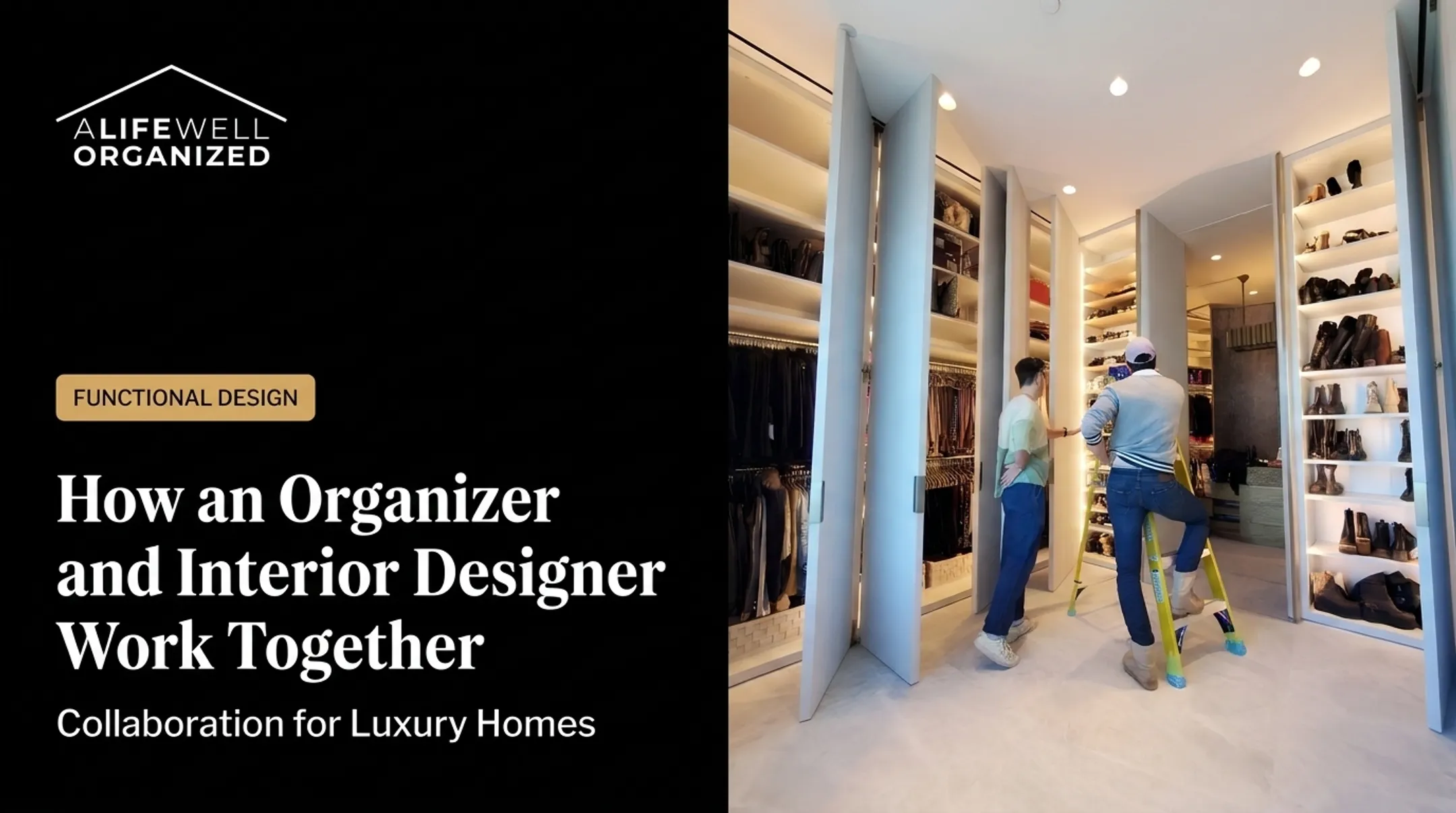
Consider hiring both when:
The home needs a reset and a refresh. Organizing first often helps, because it shows what actually needs storing and keeps you from designing around items you'll release.
Houzz's comparison separates the two roles but prescribes no universal order, so agree on sequence up front.
Before work begins, settle:
- Who owns what responsibilities
- Budget, timeline, and measurements
- Product sourcing and installation
- How the two will communicate
Hiring checklist
Ask each candidate about:
- Relevant experience and before-and-after examples or portfolio
- Credentials where applicable and references
- Confidentiality practices
- Disposal and sustainability policies
- Written deliverables and fee structure
- How they define a finished project
When you compare credentials, NAPO notes that certification isn't required to work as an organizer. The Certified Professional Organizer (CPO) credential requires 1,000 work hours within five years and an exam, so it signals real experience.
Real-World Examples and Case Studies
Architectural Digest documented a joint project. Professional organizer Clea Shearer of The Home Edit worked with designer Lindsay Rhodes on Shearer's Nashville home.
Rhodes designed a pantry with a marble archway, open shelving, drawers, and glass-front cabinets. The primary closet shows shoes and handbags in The Home Edit's color-coordinated system. Design shaped the architecture and finishes, while organizing shaped how things are stored and displayed.

That example shows collaboration, not a fixed sequence every project must follow.
ALWO's work sits on the organizing side. Client results include:
- Ivan on the Upper West Side needed help settling into a new apartment, especially closets and cabinets. He said his possessions ended up "functional and easily accessible."
- Jake, also on the Upper West Side, said the team turned "chaos and clutter" into a system sustainable for his lifestyle.
When clutter, a move, or an estate is the main challenge, systems matter most. ALWO serves New York City and the Tri-state area with confidential, NAPO-certified organizing and a complimentary evaluation. It does not provide interior design, though it works alongside designers and contractors.
Conclusion
A professional organizer is the better fit for order, decluttering, transitions, and sustainable systems. An interior designer fits best when aesthetics, furnishings, atmosphere, or renovation design come first.
Both can make a home more comfortable. Match the specialist to the problem you're solving, the outcome you want, and the scope of the project.
Frequently Asked Questions
When should you engage an interior designer?
Hire one when your goal involves layout, furnishings, finishes, lighting, décor, renovation, or a cohesive visual direction. If decluttering is the main issue, start with an organizer.
What is the difference between an organizer and a planner?
An organizer creates order in spaces, belongings, and systems. A planner generally coordinates tasks, schedules, goals, or events. Some professionals do both, so confirm the scope.
What does it take to be a professional organizer?
Organizing knowledge, communication, empathy, decision support, project management, and discretion. Training and credentials such as the CPO help, but certification isn't required to start.
What are the four types of organizing?
No universal list exists. One popular framework is Cassandra Aarssen's ClutterBug, which sorts people into four styles: Ladybug, Bee, Cricket, and Butterfly. Terminology varies between professionals.
What makes a home look cheap?
Designers point to poor scale, visual clutter, harsh or excessive lighting, and inconsistent flooring. A designer can improve cohesion, but can't replace an organizing system.
What is the 3-5-7 rule for interior decorating?
It's a styling guideline: group objects in threes, fives, or sevens for visual balance. Homes & Gardens describes it for wall art and shelves. It's a guideline, not a requirement.