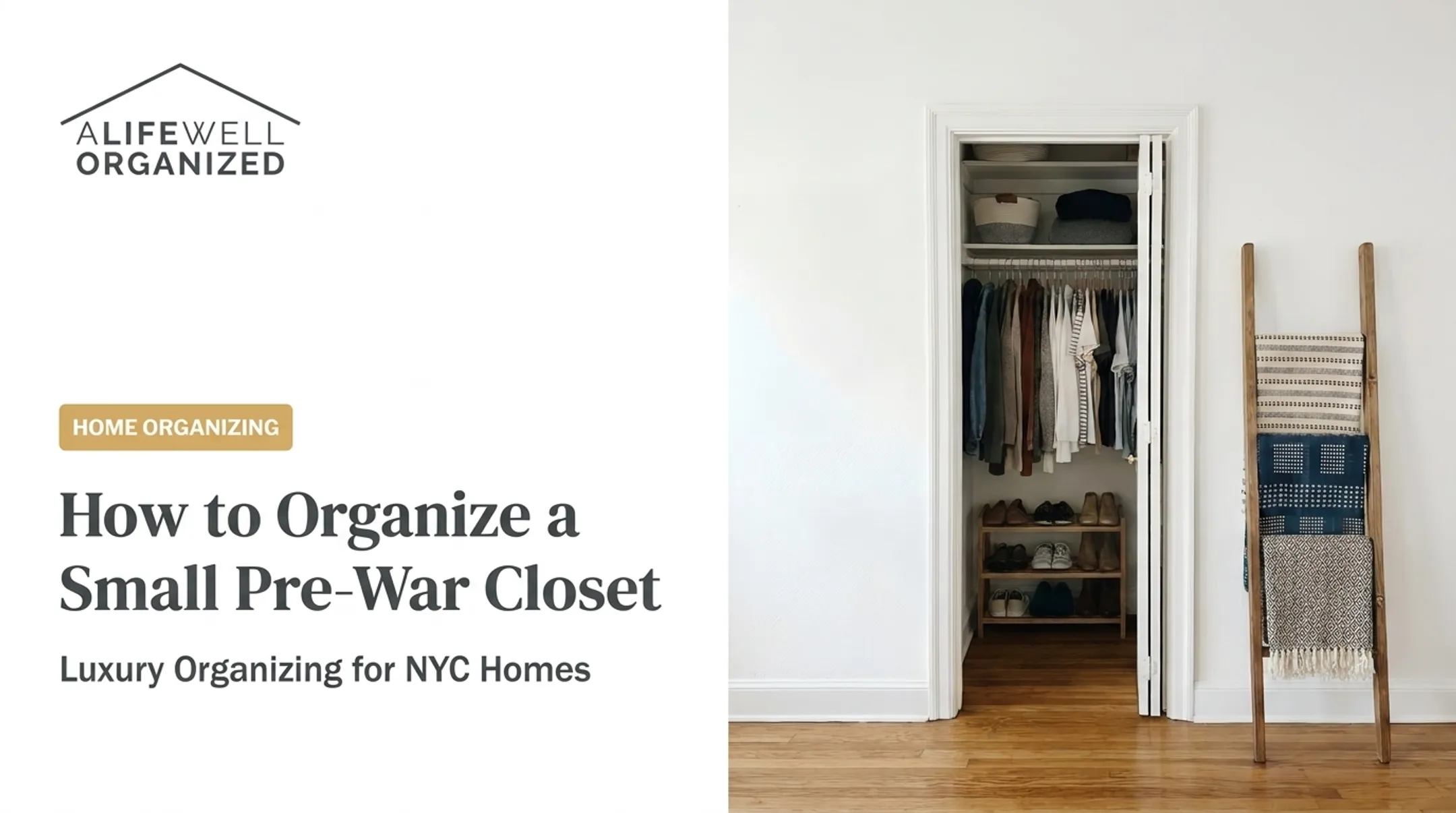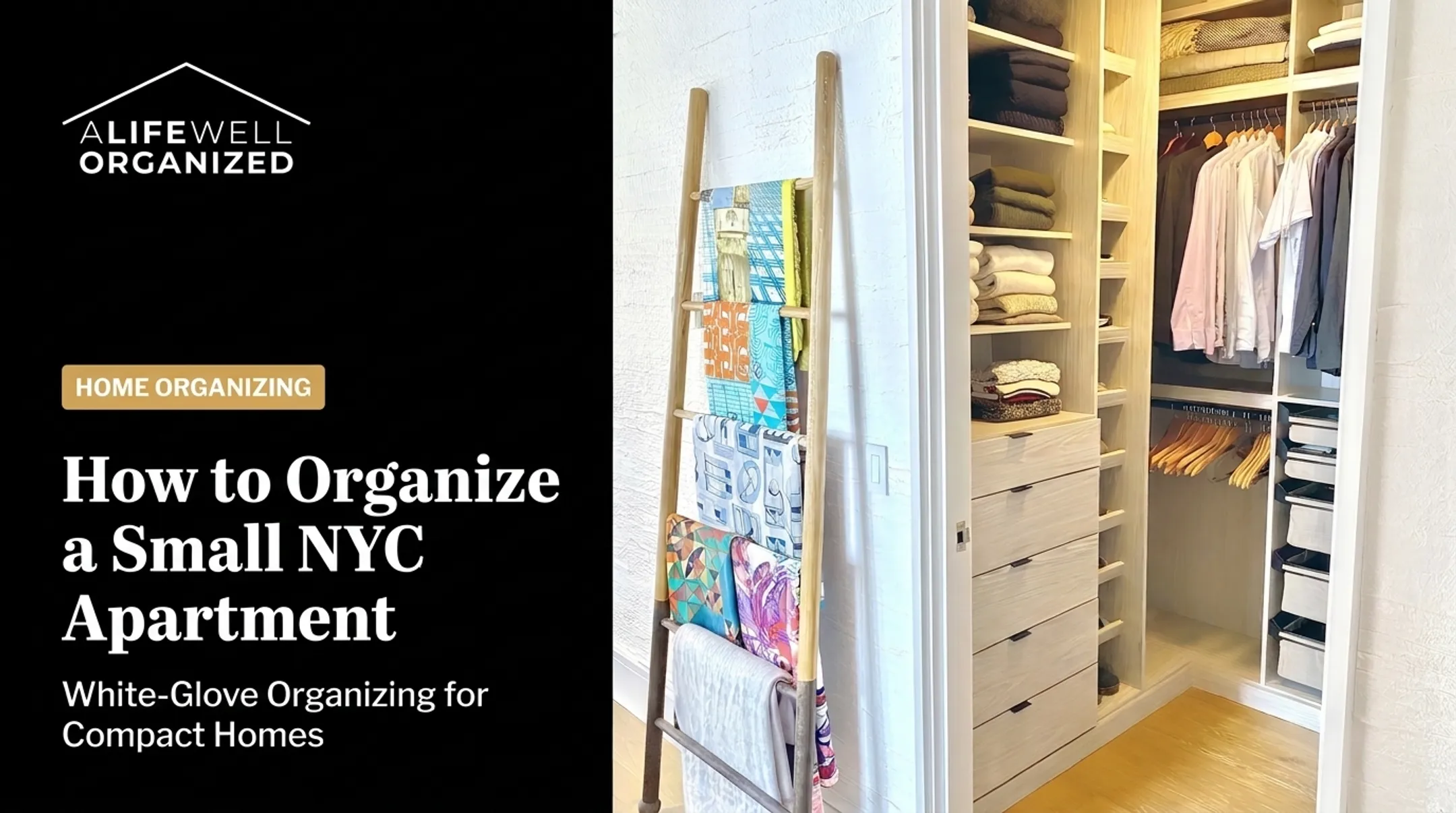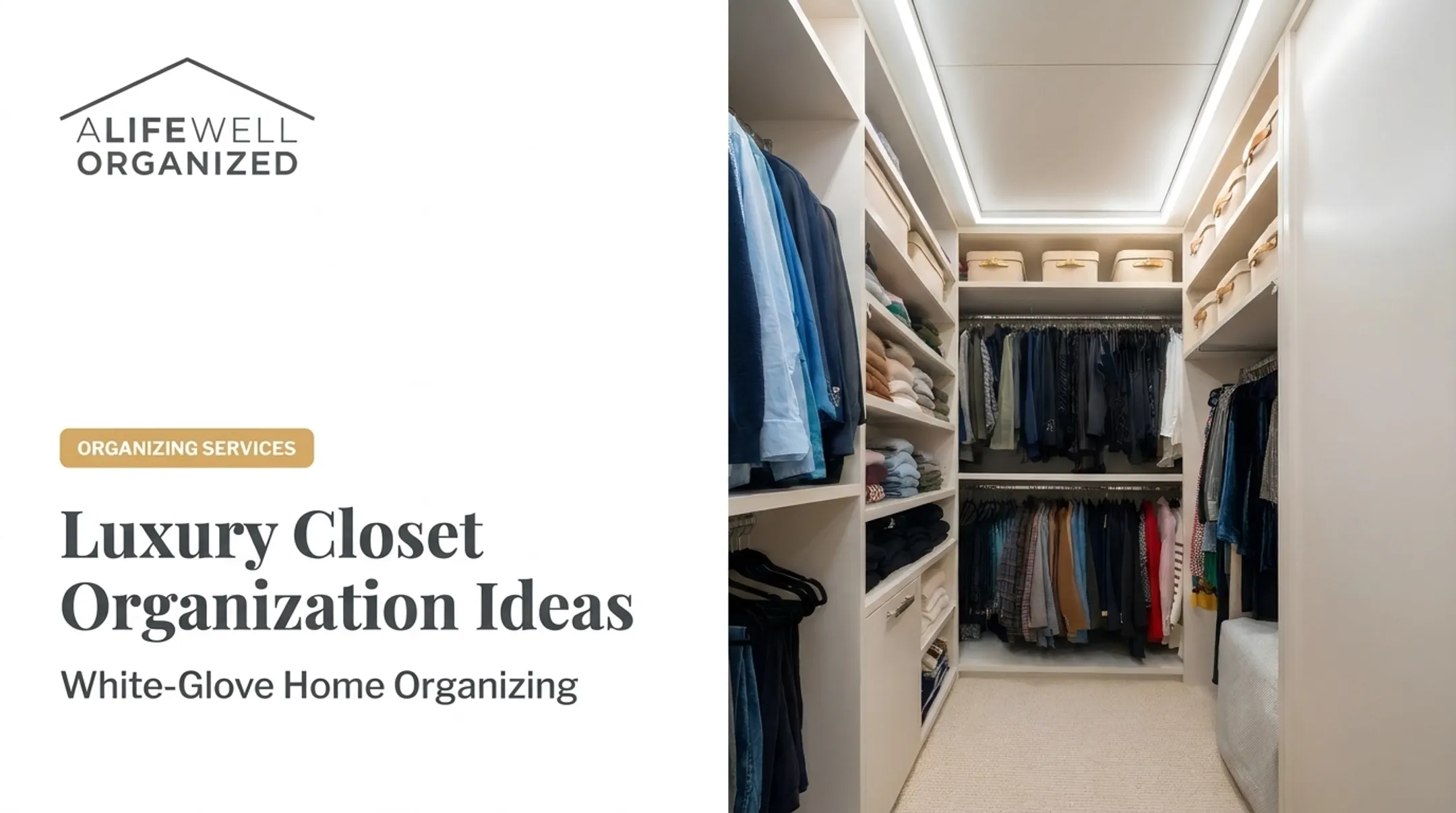

The fix isn't just more hangers. Results depend on your wardrobe, the room's dimensions, layout, accessibility, storage system, and the habits that keep it all running. This guide walks through assessing and editing, building zones, choosing storage, avoiding mistakes, and maintaining the result.
Key Takeaways
- Build the closet around how your household actually dresses, not around symmetry.
- Edit first. Buy bins, drawers, and hangers only after you know what's staying.
- Keep everyday items within easy reach; send seasonal pieces up high.
- Choose adjustable storage and leave spare capacity.
- Add a short maintenance routine so the reset lasts.
How to Organize a Primary Walk-In Closet
Step 1: Assess the Closet and Edit the Wardrobe
Start by pulling everything into view: clothing, shoes, bags, accessories, and the non-clothing items that crept in. You can't plan storage for a volume you haven't seen.
Then measure:
- Usable wall space and ceiling height
- Door swing and corners
- Existing shelves, rods, and walking paths
- Awkward features such as sloped ceilings or vents
Sort every item into one of five piles: keep, donate or sell, repair, recycle, or relocate. Let actual wear, fit, condition, and lifestyle guide you.
NAPO-GPC suggests checking size and condition and setting aside anything that no longer works; what remains is your core wardrobe. Sentimental pieces you won't wear can move to a memory box outside the closet.
Worn or stained textiles may be recyclable, but textile recycling programs such as SMART exclude wet, mildewed, or solvent-contaminated items. Check what your local program accepts.
Step 2: Design Zones Around Daily Routines
Give each category a home:
- Long-hang and short-hang garments
- Folded clothing
- Shoes and bags
- Accessories
- Laundry
- Seasonal and special-occasion pieces
Pick a sorting logic that makes retrieval and putting away easiest. California Closets sorts hanging clothes by type, then by length, and uses color to help selection. That's a sound default: category first, then color or frequency of use.
In a shared closet, assign each person a clear area. Keep shared zones for luggage, linens, laundry, or accessories.
Step 3: Match Storage to the Wardrobe
Choose rods, shelves, drawers, bins, dividers, and hooks based on what you own: quantity, shape, weight, and care needs. Containers come last.
Garment care matters here. Guidance from the Canadian Conservation Institute is written for museum collections, not everyday closets, but the principles apply:
- Fold knitwear rather than hanging it; hanging stretches knits
- Pad shoe interiors to hold their shape, and avoid stacking them
- Loosely fill handbags with acid-free tissue and store them with handles supported
- Don't hang heavy bags from delicate straps
Hang wrinkle-prone and structured pieces. Use file folding or dividers where you want to see everything at once.
Step 4: Balance Access, Appearance, and Maintenance
Put the most-worn items at comfortable reach. Use upper shelves and rear corners for seasonal, sentimental, or occasional things.
Label concealed bins, keep categories together, and leave room to return items without forcing them. Then test the system through a normal week of dressing and laundry. If something feels awkward, move it. Adjust shelf heights, containers, or categories until it flows.

When to Organize and What You Need Before Starting
A full reset pays off when your current system keeps producing clutter, items are hard to find, or the closet no longer reflects your wardrobe and routines.
When a Full Walk-In Closet Reset Makes Sense
Prioritize a reset after:
- A move or renovation
- A major lifestyle or wardrobe change
- A seasonal changeover (NAPO-GPC recommends using it to remove unwanted items)
- Quick-fix baskets and totes that have stopped working
If only one category, such as shoes or folded clothes, is the problem, a lighter edit is more efficient.
For a high-volume wardrobe, an emotionally difficult purge, a complex move, or a custom installation, a professional organizer can coordinate the process, product sourcing, and responsible donation or reuse. At A Life Well Organized (ALWO), clients don't need to tidy before the first session, and donations are sorted, bundled, and routed to agreed drop-offs.
What to Prepare
- Tape measure, labels, sorting bags or boxes
- A donation or resale plan
- Cleaning supplies
- Temporary space to stage the edit
- A category list noting hanging lengths, folded volume, shoe types, bag sizes, and special-care items
Also check the walls and hardware before adding shelves or rods. ClosetMaid's instructions distinguish drywall toggle-bolt installs from stud fastening.
Load ratings depend on the installation. One Home Depot guide rates its Regular Duty system at 20 lb per linear foot of rod, but only with studs, 1/2-inch drywall, and specified bracket spacing. That isn't a universal rod capacity.
Lighting needs attention too. The 2021 IRC requires 12 inches of clearance for surface-mounted enclosed fixtures and 6 inches for recessed ones, measured to the nearest storage. Open lamps and pendant fixtures are prohibited in closet storage spaces.
Key Parameters That Affect Results When Organizing a Primary Walk-In Closet
An attractive closet can still fail if its layout, capacity, accessibility, or upkeep doesn't fit the people using it.
Layout, Walkway, and Clearances
Width, storage depth, doorway, and corners decide whether two people can move and dress comfortably.
Is 4 feet wide enough? Technically, for a compact single-sided layout. Inspired Closets describes 24 inches for hanging plus 24 inches for passage in a 4 x 4 ft space, but calls it more "step-in" than walk-in.
Double-sided hanging needs about 6 feet. Closet America recommends 36 inches of clear walkway for comfort.
So don't judge by width alone. Measure the walkway left after storage goes in.
Wardrobe Volume and Item Composition
A closet full of dresses and suits needs different rods than one dominated by sweaters, shoes, or bags. Measure what you own:
- Linear feet of long and short hanging
- Stacks or shelf space for folded items
- Number of shoe pairs and bag sizes
Those numbers tell you which storage you need and help prevent overfilled sections or dead space.
Reference dimensions from manufacturers:
| Element | Typical guidance |
|---|---|
| Double-hang rods | About 40 in. and 80 in. |
| Long-hang rod | About 65-70 in. |
| Shelf depth | 12-15 in., up to 18 in. for bulky items |

Accessibility and Frequency of Use
Everyday pieces should be easy to see, reach, remove, and return. The ADA's unobstructed side-reach range is 15-48 inches above the floor, a useful benchmark for your daily zone. Keep seasonal items above it.
Account for user height, mobility, door swing, corner access, and lighting. For overhead storage, use a stable step stool or ladder. OSHA's stepladder guidance prohibits standing on the top step or cap, so follow the manufacturer's labels.
Flexibility and Maintenance
Adjustable shelves, spare capacity, and clearly defined homes let a closet adapt as your wardrobe changes. Build in a maintenance plan:
- Edit regularly and rotate seasonally
- Return items immediately
- Keep a defined spot for laundry, repairs, donations, and new purchases
- Try one-in, one-out; organizer Lauren Saltman says it doesn't need to be an exact swap
Common Mistakes, Troubleshooting, and Alternatives
Most closet problems come from keeping what should have been edited, buying storage before measuring, or building a system that's hard to maintain.
Common Mistakes
- Skipping the edit. Forcing everything to fit leaves no room for movement, new purchases, or easy retrieval.
- Buying matching containers first. Without measuring shelf depth, rod space, and item size, you end up with bins that don't fit.
- Overloading. Smithsonian conservators warn that cramped textile storage promotes damage; they recommend air circulation instead.
- Hiding everyday items. High, dark, or blocked spots defeat the purpose.
- Sorting by color alone. Ignoring outfit pairings, care, and the laundry return path makes upkeep harder.
Troubleshooting Issues
The closet still feels crowded. Likely causes: too many items, incomplete editing, unused vertical space. Revisit keep decisions, move seasonal items out, remove duplicates, and rebalance hanging, folded, shoe, and accessory zones.
Folded sweaters keep collapsing. Stacks are probably too tall, shelves too deep, or categories mixed. California Closets suggests about four or five sweaters per stack. Add dividers, drawers, or right-sized bins.
It looks organized but is hard to use. The system favors display over daily behavior. Move frequent items near the entrance, group outfit components, improve lighting, and simplify labels.
Alternatives to a Full DIY Closet Reset
Modular or adjustable system. Better when needs may change, the space is shared, or you want to move shelves and rods later. It offers flexibility, but still demands accurate measurements, safe installation, and editing.
Custom built-in. Better for a renovation, an irregular room, or integrated drawers, lighting, seating, or laundry. Results can be highly tailored, but it requires earlier planning, professional coordination, and a larger investment. Inspired Closets notes that size, mounting method, and drawer and door counts all drive cost.
Full-service professional organizing. Better for large wardrobes, life transitions, confidentiality concerns, or decision fatigue. It adds cost but reduces planning time and gives you an individualized system.

ALWO follows a Discover, Declutter, Organize, Balance method: consultation, guided decluttering, hands-on organizing, then habit-centered systems built for easy maintenance. Product sourcing is available too, with measuring so products fit.
Organizing fees depend on experience, geography, and scope. Construction is budgeted separately.
Conclusion
Organizing a primary walk-in closet works best when you assess the wardrobe and room before buying storage. A functional closet balances access, capacity, visual order, garment care, and the habits of the people using it.
Recurring problems usually trace back to poor editing, inaccessible layouts, overloaded storage, or systems too complicated to maintain. Depending on your closet and household, the right path may be a DIY reset, an adjustable system, a custom design, or professional support.
Frequently Asked Questions
How to properly organize a walk-in closet?
Edit your wardrobe, measure the space, then create zones for each category. Match storage to what you own, keep daily items within easy reach, and set up a simple maintenance routine.
Is 4 ft wide enough for a walk-in closet?
Only for a compact, single-sided layout with about a 24-inch passage. Depth, remaining walkway, door swing, and the number of users matter more than width alone.
What is the best way to organize a primary walk-in closet?
The best method reflects your wardrobe and routines. Use zones for hanging, folding, shoes, accessories, seasonal items, and laundry, with everyday pieces most accessible.
Should clothes be organized by type or color?
Start with type, then sort by length, color, or frequency of use within each category. No study shows one method is universally better, so choose what makes finding and returning items easiest.
How do I keep my walk-in closet organized?
Give every item one home and return it right after use. Edit seasonally, manage donations and repairs promptly, and do a periodic reset.